
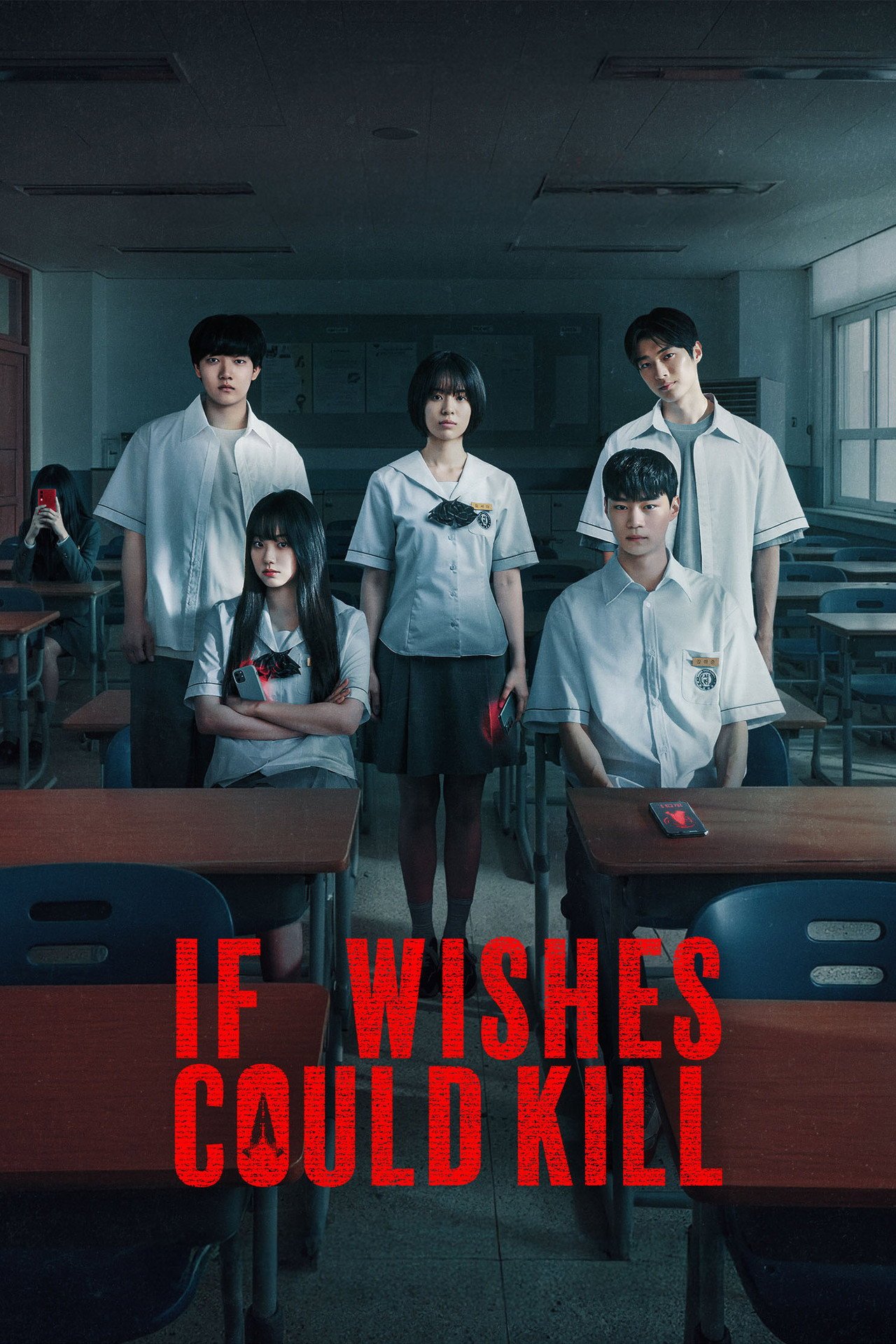
Ending Explained: If Wishes Could Kill
| Title | If Wishes Could Kill |
| Type | Tv |
| Release Date | 2026-04-24 |
| Genres | Mystery, Drama |
| Studio/Network | Netflix |
| Director/Creator | Director: Park Yoon-seo, Creator: Park Joong-seop, Creator: Park Yoon-seo |
| TMDb Rating | 7.2/10 (13 votes) |
| Where to Watch | Netflix, Netflix Standard with Ads |
The ending of If Wishes Could Kill reveals that the wish-granting app was created using data from the deceased classmate, making every granted wish a transaction paid for with someone else’s suffering. The five friends survive, but only after Se-ah destroys the app by making the one wish it cannot fulfill: undoing death itself.
I finished the final episode of If Wishes Could Kill at 2 AM, sitting in the dark with my phone screen dimmed to 3%, and I honestly didn’t move for a good ten minutes. That rarely happens to me anymore. After covering Korean mysteries for years—after OCN’s golden run and Netflix’s aggressive push into K-horror—I’ve grown accustomed to predicting where a story is heading by episode three. Park Yoon-seo and Park Joong-seop had other plans. Their collaboration doesn’t just subvert expectations; it makes you realize you were asking the wrong questions from the start.
What Happens at the End of If Wishes Could Kill?
By the penultimate episode, the walls have closed in on our five high schoolers. Se-ah (Jeon So-young), Gun-woo (Baek Sun-ho), Na-ri (Kang Mi-na), Ha-joon (Hyun Woo-seok), and Hyeong-wook (Lee Hyo-je) each made wishes through the anonymous app that appeared on their phones one ordinary afternoon—wishes that seemed harmless, even noble. Gun-woo wished for his mother’s recovery. Na-ri wished to be seen. Small, human desires. The kind anyone would make.
But the app delivered, and the delivery came with a body count. Each wish triggered a corresponding death warning—not for the wisher, but for someone connected to them. The pattern was there from the beginning, buried under the chaos of teenagers panicking and pointing fingers. The finale strips away the noise. We learn the app didn’t just predict deaths; it engineered them, siphoning life force from one person to fulfill another’s desire. The engine running this machine was built on the death of a classmate whose story the show had been quietly telling in flashbacks all along.
The final confrontation doesn’t involve a villain monologue or a dramatic chase. It’s Se-ah standing in the server room of an abandoned building, the app’s physical infrastructure humming around her, choosing to make a wish that breaks the system. She wishes for the dead classmate to come back. The app cannot process it. The paradox collapses the network. Simple, devastating, and thematically perfect.
Breaking Down the Final Scene
That server room sequence deserves closer examination. Park Yoon-seo directs it with a restraint that borders on uncomfortable—the camera holds on Se-ah’s face for an unbroken stretch that feels longer than it actually is, and the only diegetic sound is the whirring of servers. No swelling score. No dramatic lighting shift. Just Jeon So-young’s eyes doing the heavy lifting.
What struck me on rewatch is how the framing positions Se-ah physically inside the machine. The servers tower around her like walls, and the blue indicator lights create this cold, clinical atmosphere that stands in stark contrast to the warm, oversaturated flashbacks we’ve seen throughout the series. She’s literally inside the apparatus of exploitation, and she destroys it from within. That’s not accidental. The Parks are visual storytellers first, and this composition says everything about their thesis: the only way to dismantle a system built on invisible suffering is to enter it and refuse to play by its rules.
Gun-woo’s arc in the finale also deserves mention. Baek Sun-ho plays the moment Gun-woo realizes his wish for his mother’s healing directly caused another family’s grief with a stillness that’s almost unbearable. He doesn’t cry. He doesn’t shout. He just… stops. The camera pulls back slowly, and we watch him shrink into the frame—a boy who got exactly what he wanted and would give it all back if he could.
Hidden Details You Might Have Missed
The show rewards patient viewers. On my second watch, I caught at least three details that reframed entire episodes.
First: the classmate’s name appears in the background of episode one, scratched into a desk during the scene where the friends first discover the app. I had to pause and squint, but it’s there. The Parks planted the answer in plain sight before we even knew there was a question.
Second: every time a wish is granted, there’s a brief audio glitch—a half-second of static that most viewers will chalk up to sound design. It’s actually a distorted clip of the deceased classmate’s voice, pulled from what appears to be a school announcement recording. The app is literally running on their voice, their data, their digital remains. It’s a chilling commentary on how we extract value from the dead without consent—how social platforms and data brokers already operate on similar logic, just with less immediately fatal consequences.
Third: Na-ri’s phone wallpaper changes after each wish she makes, gradually shifting from a bright photo of the friend group to increasingly isolated images of just herself. By the final episode, her wallpaper is a selfie she never took. The app has been curating her identity, reshaping her self-image around the wishes she’s made. Kang Mi-na mentioned in a press interview that she chose each wallpaper deliberately, and knowing that makes the progression even more unsettling.
What Does the Ending Mean?
At its core, If Wishes Could Kill is about the lie of consequence-free desire. We live in a culture that sells wishes constantly—buy this, subscribe here, optimize yourself, manifest your reality. The show asks a question most of us avoid: if your wish came true, would you want to know what it cost?
The app is a metaphor for every system that delivers convenience through invisible exploitation. Fast fashion. Gig economies. Algorithmic feeds that serve us content mined from underpaid labor. The five friends aren’t evil for making wishes; they’re ordinary people who did what anyone would do when offered something for apparently nothing. The tragedy isn’t their desire—it’s their inability to see the machinery behind it.
Se-ah’s final wish functions as the show’s moral anchor. She doesn’t wish for survival or safety or even forgiveness. She wishes for the one thing the system cannot provide: reversal of its foundational crime. In doing so, she acknowledges that you cannot build justice on top of exploitation. The app had to be destroyed, not reformed. Not regulated. Destroyed.
Some viewers will find this too absolute. I understand that criticism. But I think the Parks are making a specifically Korean argument here, one that resonates with the country’s ongoing reckoning with digital platform ethics and the human cost of its tech boom. The ending isn’t offering a policy solution. It’s offering a philosophical one: sometimes the only ethical choice is to refuse the game entirely.
Fan Theories Worth Considering
The Reddit threads for this show have been genuinely fascinating—less toxic than usual, more collaborative. Three theories in particular have gained traction, and I have thoughts on each.
The most popular theory argues that the app didn’t actually grant wishes at all—it simply predicted outcomes that were already going to happen and took credit for them. This would make the entire system a placebo built on confirmation bias. It’s a clever read, but I don’t buy it. Episode five shows Gun-woo’s mother’s medical charts changing in ways that her doctors describe as medically impossible. The app did something real. Whether that “something” was supernatural or technological is the wrong debate; the point is that the effect was genuine and the cost was hidden.
The second theory posits that Hyeong-wook was aware of the app’s true nature earlier than he let on. Lee Hyo-je’s performance does carry an odd weight in episodes three and four—his expressions suggest someone wrestling with knowledge he hasn’t shared. I find this plausible but ultimately unproven based on what’s on screen. If a second season materializes, this thread could absolutely be pulled.
The third theory, and my personal favorite, suggests the deceased classmate created the app before dying—not as a malicious act, but as a desperate attempt to remain connected to the living world. Under this reading, the app is a ghost story in the most literal sense: a dead person’s final wish, spiraling out of control. This aligns beautifully with the show’s themes and adds a layer of tragedy that makes the ending even more painful. I sincerely hope this is canon.
📰 More From Watchlist Wizard
Frequently Asked Questions
Will there be a season 2 of If Wishes Could Kill?
Netflix hasn’t officially confirmed a second season as of April 2025. However, the show’s strong performance on the platform and the deliberately open-ended nature of Hyeong-wook’s final scene suggest the creators left room to continue. The TMDb rating of 7.2 indicates solid audience reception, which typically factors into renewal decisions.
Who is the dead classmate connected to the app in If Wishes Could Kill?
The deceased classmate’s identity is revealed gradually through flashbacks woven across the season. Their death preceded the app’s appearance, and their personal data—social media posts, search history, voice recordings—became the raw material the app used to process and grant wishes. The connection is the emotional and ethical center of the entire series.
What did Se-ah wish for at the end of If Wishes Could Kill?
Se-ah wished for the dead classmate to return to life. This wish created an unresolvable paradox for the app, which operated on the principle of exchanging one person’s fate for another’s desire. Since the classmate’s death was the foundation of the system itself, reversing it collapsed the entire network.
Is If Wishes Could Kill based on a webtoon or original story?
The series is an original creation by Park Joong-seop and Park Yoon-seo, not adapted from existing source material. The creators have cited Korean urban legends about wish-granting entities and contemporary anxieties about data privacy as primary influences on the story’s development.
Ready to watch If Wishes Could Kill?
Check out our complete streaming guide to find out where you can watch it right now.