
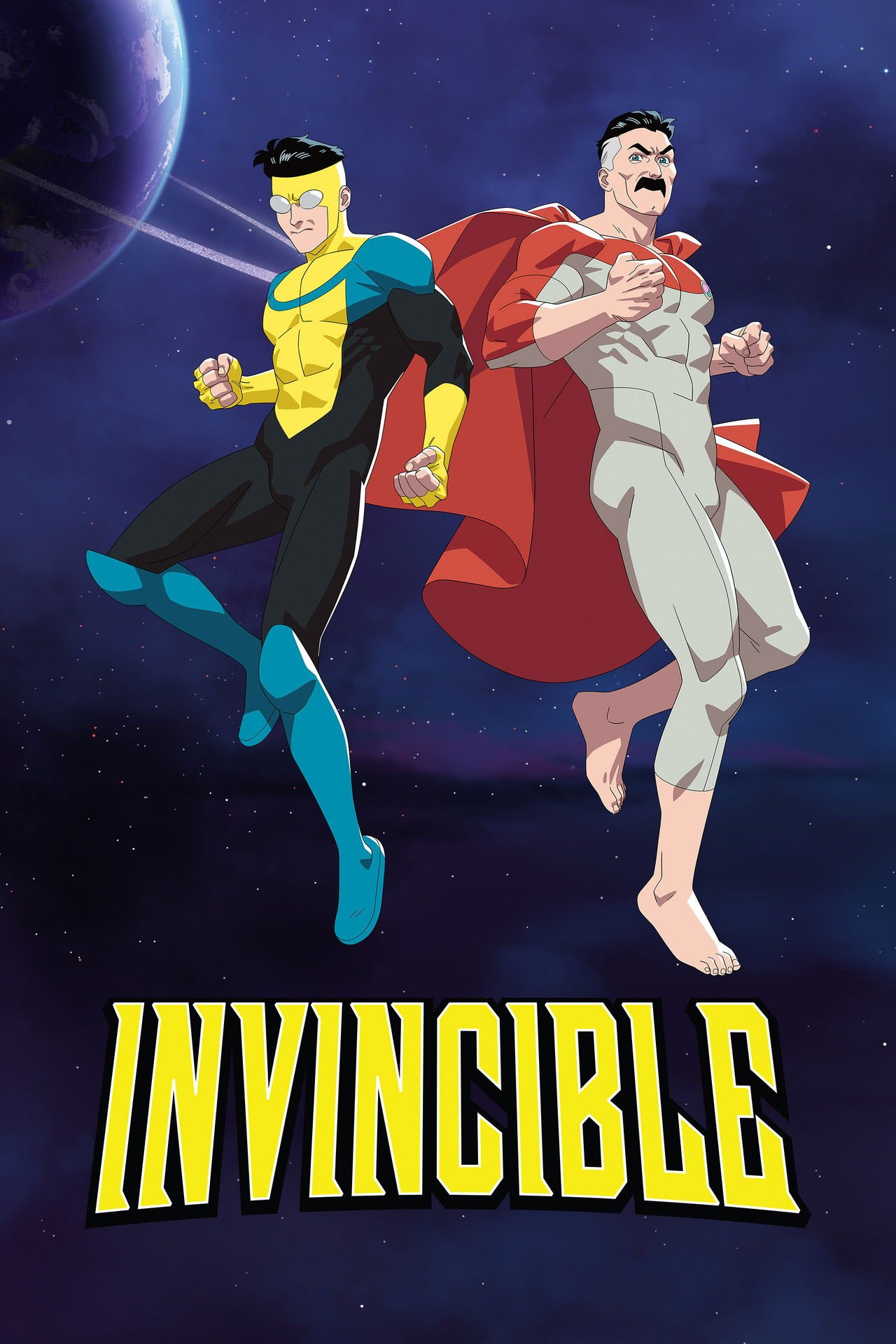
In-Depth Review: INVINCIBLE
| Title | INVINCIBLE |
| Type | Tv |
| Release Date | 2021-03-25 |
| Genres | Animation, Drama, Sci-Fi & Fantasy, Action & Adventure |
| Studio/Network | Prime Video |
| TMDb Rating | 8.6/10 (5578 votes) |
| Where to Watch | Amazon Prime Video, Amazon Prime Video with Ads |
INVINCIBLE is a Prime Video animated series that fuses coming-of-age drama with bone-crunching superhero action, earning an 8.6/10 on TMDb and redefining what adult animation can achieve in the genre.
I remember the exact moment I realized this show was something different. Episode 1 had wrapped up with that familiar teenage-superhero warmth — earnest dad talks, tentative first flights, the whole package. Then the final minutes hit, and my jaw actually dropped. Not the polite “oh, interesting” kind of drop. The visceral, “did they just do that?” kind. That whiplash — between comfort and horror, between Saturday-morning nostalgia and adult consequences — is the engine that has powered INVINCIBLE since its March 2021 premiere, and it’s why three seasons in, I’m still unable to look away.
Overview of INVINCIBLE
Created for Prime Video and based on Robert Kirkman’s sprawling comic series, INVINCIBLE premiered on March 25, 2021, and almost immediately carved out a space that no other animated superhero show occupies. The premise reads deceptively simple: seventeen-year-old Mark Grayson, son of the world’s greatest hero Omni-Man, finally gets his powers and starts learning the family business. That elevator pitch could sell a CW show. What it actually delivers is something far messier, more emotionally sophisticated, and occasionally more shocking than anything live-action superhero television has attempted in years.
The series operates across multiple genres simultaneously — animation, drama, sci-fi and fantasy, action and adventure — and the remarkable thing is how comfortably it wears all of them. One episode can feel like a high school dramedy, the next like a political thriller, the next like a horror film. The animation style, with its clean lines and bold colors, deliberately evokes the Saturday-morning cartoons many of us grew up on. That visual vocabulary becomes a weapon the show wields with precision, lulling you into nostalgia before shattering the frame with consequences that feel genuinely earned rather than gratuitous.
With a TMDb rating of 8.6 from over 5,500 votes, the audience consensus is clear: this isn’t just good superhero television. It’s some of the best the genre has produced in any format this decade.
My Take on INVINCIBLE
On first watch, I treated INVINCIBLE like comfort food. The pilot’s first half — Mark’s awkward teen years, his adoring relationship with his father, the giddy thrill of first flight — gave me exactly the warm, fuzzy feelings I expected from an animated superhero story. I was halfway through a second cup of coffee when the tone shift arrived, and I’ve rarely felt so manipulated in the best possible way. The show earned that twist not through cheap shock value but through careful, deliberate character work that made the betrayal feel inevitable in retrospect.
Rewatching the early episodes later, I caught dozens of breadcrumbs I’d missed. A throwaway line of dialogue. A slightly too-long pause. An expression crossing a character’s face that I’d originally read as stoicism but now recognized as something far darker. That rewatchability factor alone separates INVINCIBLE from the disposable content conveyor belt. This is constructed storytelling, not episodic filler designed to keep you scrolling.
What resonates most deeply, though, isn’t the spectacle. It’s the emotional architecture underneath. Mark’s journey isn’t just about learning to punch harder or fly faster — it’s about the agonizing process of discovering that the people you love most can be capable of unthinkable things, and that forgiving them (or not) is a choice you’ll have to live with forever. That’s not a superhero theme. That’s a human one, and the show never lets you forget it.
What INVINCIBLE Gets Right (And Wrong)
No show this ambitious avoids missteps entirely, and honesty matters more than hype here. So let’s walk through what works, what stumbles, and where the series genuinely surprises.
Cinematography & Visual Style
Animation cinematography rarely gets the critical attention it deserves, perhaps because we conflate “animated” with “less cinematic.” INVINCIBLE makes that assumption look foolish. The show’s visual identity leans into bold, comic-book-inspired compositions — heavy outlines, saturated palettes, dynamic panel-like framing — but deploys them with genuine sophistication. Action sequences utilize depth of field and camera movement in ways that feel genuinely cinematic rather than merely illustrative. A late-season fight that shifts through multiple environments doesn’t just show you cool locations; it uses each setting’s visual language to tell you something about the characters fighting there.
The color grading deserves particular praise. Scenes set in the Grayson household glow with warm amber tones that telegraph safety and family, while Omni-Man’s solo sequences often carry a sterile, slightly desaturated quality that I initially read as “superhero gravitas” but came to understand as emotional distance. That kind of visual storytelling operates below conscious awareness, shaping your emotional response before your brain catches up with the plot.
Where the visuals occasionally falter is in budget-conscious moments. Certain episodes feature noticeably fewer frames of animation during dialogue scenes, creating an almost jerky quality that pulls you out of the otherwise immersive world. These shortcuts are understandable given the scale of the production, but they’re noticeable, and in a show that asks you to invest deeply in its characters, any moment that breaks that investment is a real cost.
Acting Performances
The voice cast here is, to put it plainly, absurdly strong for an animated series. Steven Yeun brings a vulnerability to Mark that makes every setback feel personal. His line readings during the show’s quieter moments — a hesitant conversation with a friend, a strained phone call home — carry a naturalistic texture that animated performances too often lack. Yeun doesn’t perform “animated character.” He performs a real kid dealing with impossible circumstances, and the difference is audible.
Sandra Oh as Debbie Grayson is the show’s secret weapon. Her performance could have easily fallen into the “worried mother” archetype that superhero stories default to, but Oh finds dimensions in Debbie that the writing alone doesn’t always provide. A scene where Debbie processes grief — I won’t specify which — relies almost entirely on Oh’s vocal tremor and carefully measured silences, and it wrecked me more thoroughly than any of the show’s more explosive moments.
J.K. Simmons as Omni-Man does what J.K. Simmons does: he commands every scene he’s in with a voice that carries equal parts warmth and menace. The genius of his performance is that both registers feel completely authentic. When Omni-Man sounds like a loving father, you believe him. When he sounds like something else entirely, you believe that too. That duality isn’t just good acting — it’s the show’s thematic thesis made audible.
The supporting cast, while generally solid, occasionally suffers from what I’d call “celebrity voice actor syndrome.” Certain guest performances feel distractingly recognizable in a way that serves the show’s marketing more than its storytelling. A few cameo voices pulled me out of the narrative entirely, which is the opposite of what good voice acting should accomplish.
Pacing & Story Structure
INVINCIBLE’s structural approach is one of its most distinctive features and also one of its most frustrating. The show embraces long-form serialization with a confidence that streaming television makes possible but few series actually commit to. Storylines seeded in early episodes don’t pay off for entire seasons. Character arcs that seem resolved get reopened with new complications. This is ambitious, adult storytelling that treats its audience as capable of patience and delayed gratification.
But patience has limits. Several mid-season episodes across the show’s run suffer from significant pacing sag, particularly when balancing its ensemble cast. B-plines involving supporting characters sometimes feel like they exist to fill episode runtime rather than to advance the narrative in meaningful ways. A particular subplot involving a supporting hero’s personal life, while not without charm, consumed screen time that could have been better spent on the show’s core emotional dynamics. I found myself checking the progress bar during these stretches — never a good sign.
The season finales, by contrast, are masterclasses in escalation and payoff. Each one manages to tie together threads you’d forgotten were still dangling while detonating new narrative landmines that leave you staring at the screen as credits roll. The structural discipline required to make that work across multiple seasons is genuinely impressive, even when the journey between highlights occasionally drags.
Soundtrack & Atmosphere
The score does something I didn’t expect from a superhero show: it gets quiet when you’d anticipate bombast. During several of the series’ most intense sequences, the soundtrack pulls back to near-silence, letting sound design — the crunch of impact, the rush of air, a ragged breath — carry the emotional weight. It’s an approach reminiscent of what Jonny Greenwood achieved in certain tense sequences of film scores for prestige dramas, where the absence of music becomes more overwhelming than its presence.
When the music does swell, it earns that escalation. The show’s main theme encapsulates this balance perfectly: deceptively gentle opening notes that build into something grand and slightly unsettling. It mirrors the series’ own tonal trajectory — a promise of warmth that gradually reveals something far more complex underneath.
Atmospheric sound design throughout is meticulous. The different alien environments Mark encounters each carry distinct sonic signatures — layered ambient textures that communicate strangeness without relying on visual exposition. You can hear the otherworldliness before you see it, which is exactly how good sound design should function.
Why INVINCIBLE Stands Out
To understand what makes this series exceptional, it helps to position it against its closest peers. Three shows come to mind: Amazon’s own The Boys, HBO’s Watchmen, and the earlier animated entry Young Justice.
The Boys shares INVINCIBLE’s interest in superhero deconstruction and corporate critique, but where that live-action series leans heavily into satire and grotesque spectacle, INVINCIBLE operates from a place of genuine emotional investment. The violence here isn’t played for shock or dark comedy — it carries weight, consequence, and genuine grief. When characters suffer in INVINCIBLE, the show mourns them. When characters suffer in The Boys, the show serves them up as commentary. Both approaches are valid, but INVINCIBLE’s emotional sincerity gives its horror a resonance that pure satire can’t achieve.
HBO’s Watchmen tackled similar thematic territory — the cost of power, the lies we tell about our heroes — but did so through a dense, literary lens that demanded active intellectual engagement. INVINCIBLE is no less thematically rich, but it accesses its ideas through character rather than through puzzle-box narrative. You don’t need to decode symbolism or parse historical allegory to feel what this show is saying. It hits you in the gut first and the head second.
Young Justice remains the gold standard for animated superhero ensemble storytelling, and INVINCIBLE clearly learned some lessons from its predecessor’s approach to serialization and character development. But where Young Justice operates within the moral boundaries of its DC Universe home, INVINCIBLE pushes into territory that mainstream superhero animation has historically avoided. The freedom to show real consequences — physical, emotional, moral — transforms the genre’s familiar beats into something that feels genuinely unpredictable.
What unites these comparisons is a shared understanding that superhero stories are only as compelling as their characters’ struggles. INVINCIBLE doesn’t just understand this principle — it embodies it with a consistency that makes its few missteps forgivable and its successes resonant.
Is INVINCIBLE Worth Watching?
Yes — with one important caveat. This is not a show for children, despite its animated format. The TV-MA rating is earned through graphic violence, mature themes, and emotional complexity that would be lost on younger viewers. If you’re looking for something to watch with your kids on family movie night, this isn’t it.
For adult viewers, though, INVINCIBLE represents some of the most confident superhero storytelling currently running on any platform. Its combination of character depth, genuine stakes, and willingness to follow its narrative logic to uncomfortable places makes it essential viewing for anyone who believes the genre can be about more than spectacle. The first few episodes require patience — the show’s full power doesn’t become apparent until its foundations are laid — but the payoff is extraordinary.
Streaming exclusively on Amazon Prime Video, it’s accessible to anyone with a subscription. Start from the beginning. Don’t skip ahead. Let it earn its revelations the way it wants to. You’ll know by the end of the pilot whether this show is for you, and if it is, you’re in for one of the most rewarding genre experiences on television.
📰 More From Watchlist Wizard
Frequently Asked Questions
Is Invincible season 4 canceled?
No, INVINCIBLE season 4 has not been canceled. Prime Video has demonstrated strong commitment to the series, and production continues. Any rumors of cancellation appear to be unfounded, though official release dates should always be confirmed through the network’s announcements rather than social media speculation.
Is Invincible a kid show?
Absolutely not. Despite its animated format, INVINCIBLE carries a TV-MA rating for graphic violence, mature themes, and intense emotional content. The show’s visual style may evoke Saturday-morning cartoons, but its storytelling is firmly aimed at adult audiences. This is one of the most common misconceptions about the series, and one that could lead to an uncomfortable surprise if parents assume animation equals family-friendly.
Does Invincible have LGBTQ representation?
Yes, the series includes LGBTQ characters and relationships as part of its broader ensemble. These elements are integrated naturally into the show’s world rather than treated as Very Special Episodes, which is how representation works best — as simply one dimension of characters who are fully realized people rather than defined solely by their identities.
Why is Invincible such a good show?
INVINCIBLE succeeds because it treats its characters as genuine people navigating impossible circumstances rather than archetypes fulfilling genre obligations. The writing earns its twists through careful foreshadowing, the voice cast brings remarkable emotional depth, and the show’s willingness to depict real consequences — physical, emotional, moral — creates stakes that feel genuinely urgent. Add to that a visual style that weaponizes nostalgia against the viewer’s expectations, and you have a series that doesn’t just execute superhero tropes well but actively redefines what they can accomplish.
Ready to watch INVINCIBLE?
Check out our complete streaming guide to find out where you can watch it right now.