
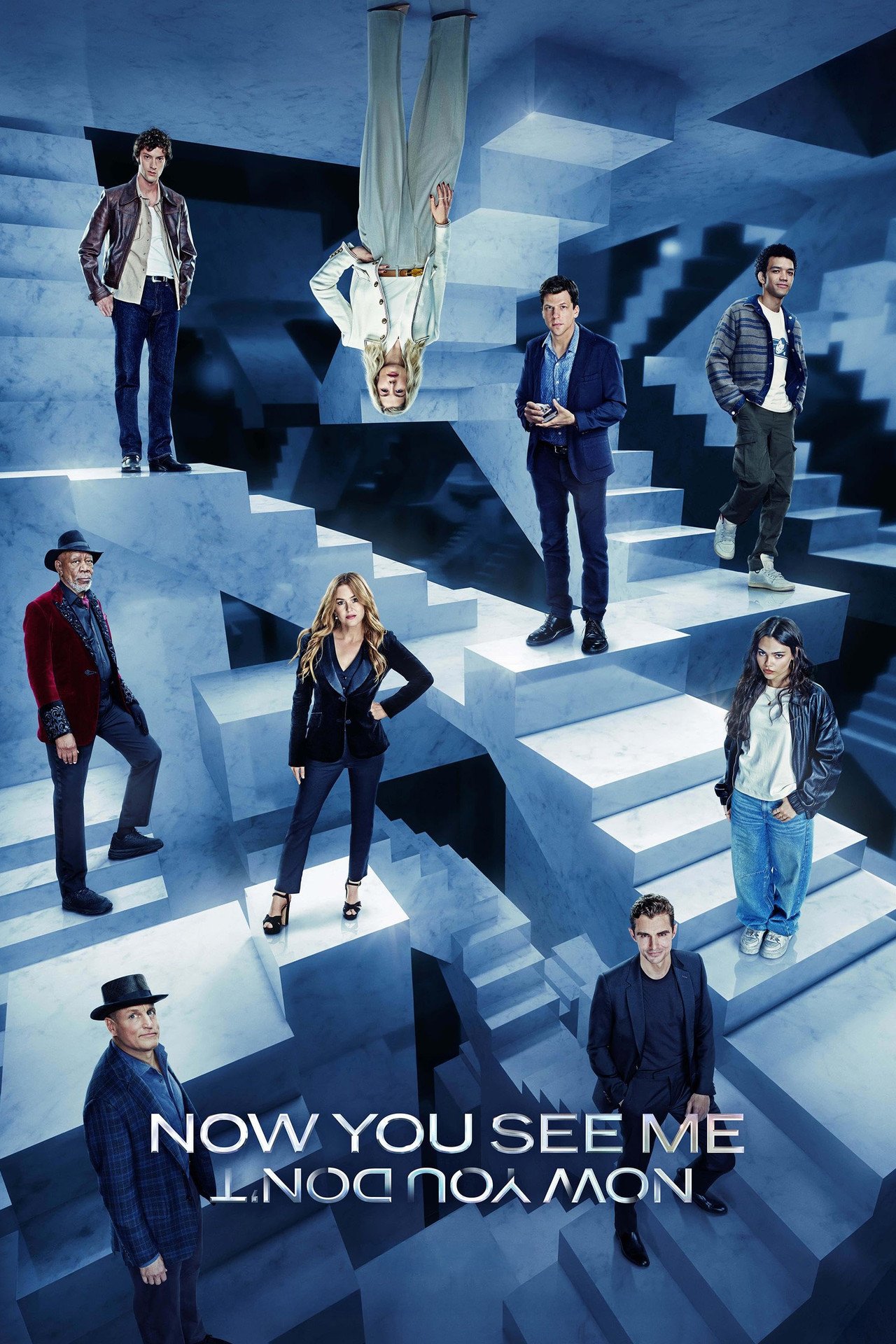
Ending Explained: Now You See Me: Now You Don’t
| Title | Now You See Me: Now You Don't |
| Type | Movie |
| Release Date | 2025-11-12 |
| Genres | Crime, Thriller |
| Runtime | 113 min |
| Studio/Network | Lionsgate |
| Director/Creator | Director: Ruben Fleischer |
| TMDb Rating | 6.5/10 (1378 votes) |
| Where to Watch | Starz Apple TV Channel, Starz Roku Premium Channel, Starz |
The ending of Now You See Me: Now You Don’t reveals the Horsemen’s ultimate trick: dismantling Veronika Vanderberg’s criminal empire from within. The film closes on a passing-of-the-torch moment, blending old and new illusionists while teasing a larger network still in play.
I’ve been sitting with this finale for days, and honestly? It’s messier than the first two films, but somehow more satisfying. Ruben Fleischer’s entry into the franchise trades Louis Leterrier’s slick Euro-energy and Jon M. Chu’s hyperkinetic flash for something rougher, more chaotic, and — at its best — more emotionally grounded. The 113-minute runtime barely contains the ensemble, yet the last twenty minutes crackle with a tension this series hasn’t earned since Woody Harrelson’s twin reveal in the sequel. Whether that payoff lands for you depends entirely on how much patience you have for magicians who keep moving the goalposts.
What Happens at the End of Now You See Me: Now You Don’t?
The third act pivots hard from heist spectacle into something closer to a moral reckoning. After spending most of the film working separate angles — J. Daniel Atlas clinging to his old-school showmanship while the new generation pushes riskier, tech-augmented illusions — the combined crew finally synchronizes for their most ambitious heist yet. The target isn’t just Veronika Vanderberg’s diamonds. It’s the entire infrastructure of her operation: the money laundering pipelines, the trafficking networks, the political cover she’s purchased over decades.
Rosamund Pike’s Vanderberg gets exactly the sendoff a villain of her caliber deserves. She’s not defeated in some explosive showdown. She’s dismantled piece by piece, her reputation and empire stripped away publicly, methodically — the way the Horsemen have always punished their targets. The irony is brutal: a woman who built her fortune on making things disappear gets disappeared herself. Her assets vanish. Her accounts drain. Her political allies scatter. By the time the final card drops, she’s not even a cautionary tale — she’s just gone.
But the real weight of the ending sits with the magicians, not the mark. Atlas, who spent two movies as the arrogant center of the Horsemen, finally steps aside. Not because he’s lost his edge, but because he recognizes the game has evolved beyond him. The torch passes to the new generation — Bosco (Dominic Sessa), June (Ariana Greenblatt), and Charlie (Justice Smith) — each carrying a distinct skill set that makes the original Horsemen feel almost analog by comparison.
Breaking Down the Final Scene
The last shot lingers on a locked door. Behind it, we’re told, lies the next chapter — a room the Horsemen have never entered, connected to a network older and more vast than anything they’ve encountered. It’s a classic franchise tease, but Fleischer shoots it with genuine unease. The door doesn’t swing open triumphantly. It stays shut. And that restraint is what makes it work.
Compare this to the endings of the previous films. The first movie closed with Mark Ruffalo’s Dylan Rhodes stepping into the Eye’s inner sanctum — a reveal that felt earned but also a little too neat. The sequel doubled down with its twin-Horseman twist and labyrinthine mythology, piling questions on questions until the whole thing threatened to collapse under its own cleverness. Now You Don’t takes the opposite approach. It answers just enough to feel complete while leaving the door — literally — cracked for what comes next.
The emotional core of the finale, though, belongs to Atlas. Jesse Eisenberg has always played this character with a defensive arrogance that masks genuine insecurity, and here that mask finally slips. When Atlas acknowledges that the new generation doesn’t need him, Eisenberg underplays the moment beautifully. No grand speech. No tearful farewell. Just a slight shift in posture, a beat of silence, and then he’s walking away. It’s the quietest moment in a franchise built on spectacle, and it hits harder than any vanishing act.
The Vanderberg Takedown — Why It Works
Pike’s performance deserves special scrutiny in these closing sequences. She plays Veronika not as a cackling villain but as a businesswoman who genuinely doesn’t understand why anyone would object to her enterprise. Her confusion in the final reveal isn’t theatrical — it’s procedural. She’s processing the logistics of her own destruction in real time, running calculations that no longer compute. It’s a chilling, specific choice that elevates the character above typical thriller antagonists.
The takedown itself operates on the series’ established logic: public shaming as justice. The Horsemen have always been vigilantes who weaponize spectacle, and Vanderberg’s exposure follows that template faithfully. But Fleischer adds a layer of visceral satisfaction by showing the collateral damage of her empire — the trafficking victims, the laundered funds traced to real harm — making the spectacle feel earned rather than arbitrary.
Hidden Details You Might Have Missed
On a rewatch, the film plants seeds for its finale with surprising subtlety. Here’s what caught my eye the second time around:
The mirror motif. Fleischer and his cinematographer frame Vanderberg almost exclusively through reflective surfaces — windows, glass tables, polished diamond cases — long before the reveal that her empire is essentially a mirror of the Eye itself. She’s running a parallel organization with parallel secrets, and the visual coding tips you off before the script does.
Atlas’s watch. Eisenberg wears a different timepiece than in the previous films. It’s not a stylistic choice — it’s a plot one. The watch face displays coordinates, and if you pause the right frames during the second-act casino sequence, those coordinates point to Vanderberg’s primary vault. The prop department earned their paycheck here.
June’s card tricks. Ariana Greenblatt’s character performs close-up card manipulation throughout the film, and the specific sequences of her shuffles aren’t random. Each arrangement corresponds to a phase of the final heist. It’s the kind of obsessive detail that rewards frame-by-frame analysis without being essential to casual viewers — exactly how Easter eggs should function.
The sound design in the vault scene. Listen closely during the infiltration sequence: the ambient hum isn’t a generic tone. It’s a slowed-down recording of Vanderberg’s voice from an earlier press conference, layered beneath the score. The message is subconscious but clear — her own words are literally the background noise of her undoing. That’s the kind of audio trick I associate with the David Fincher school of sound design, and it shows Fleischer reaching for a sophistication his earlier comedies never required.
What Does the Ending Mean?
Strip away the flash, and Now You Don’t is grappling with obsolescence. Atlas isn’t just passing a torch — he’s confronting the fact that his entire paradigm for magic has been surpassed. The new Horsemen use technology he doesn’t fully understand, target threats more systemic than he ever attempted, and operate with a collaborative instinct that his ego never permitted. His arc isn’t tragic, but it’s bittersweet: he’s relevant enough to contribute, but not enough to lead.
The film also interrogates whether spectacle alone constitutes justice. Vanderberg’s public destruction satisfies the audience-within-the-audience, but does it actually repair the damage she caused? The trafficking networks are exposed but not dismantled. The laundered money is seized but not returned to its victims. The Horsemen create a satisfying narrative of comeuppance, but the material consequences remain ambiguous. That tension feels intentional — a franchise that once celebrated the pure joy of misdirection now asking whether misdirection can ever be enough.
Then there’s the Eye itself. The shadowy organization has loomed over all three films, and this ending suggests it’s less a benevolent guild of magicians and more something closer to an intelligence apparatus — recruiting operatives, deploying them against specific targets, maintaining an ideology that justifies enormous collateral damage. The locked door at the end isn’t an invitation. It’s a warning.
Fan Theories Worth Considering
Vanderberg Was Once a Horseman
This theory has gained serious traction online, and I can see why. Pike plays Veronika with a magician’s instinct for misdirection — she’s always performing, always controlling perception. Several fans have pointed out that her knowledge of the Eye’s internal structure seems suspiciously precise for an outsider. My read: the film deliberately leaves this ambiguous. If she was once part of the organization, her criminal empire becomes a dark mirror of the Eye’s own vigilante structure — same methods, opposite ethics. That parallel is more interesting than a simple confirmation, so I hope it stays unconfirmed.
Atlas Isn’t Actually Leaving
Eisenberg’s departure feels a little too clean for a franchise that’s never met a twist it didn’t like. Some viewers have speculated that his walkaway is itself an illusion — that he’s positioning himself as a deep-cover asset within whatever lies beyond that locked door. Honestly? I doubt it. The franchise has already pulled the “he was secretly there the whole time” card with Ruffalo, and repeating that structure would feel lazy. Atlas’s exit gains power from being genuine. Sometimes a cigar is just a cigar, and sometimes a magician simply walks offstage.
The New Horsemen Are the Eye’s Next Experiment
Bosco, June, and Charlie weren’t recruited by the existing Horsemen — they were selected by someone higher up. The film hints that the Eye curates its operatives with surgical precision, and these three represent a generational shift in methodology. If the Eye is essentially running a long-game experiment in how magic can reshape power structures, the new trio might be Version 3.0 — more adaptable, less ego-driven, more effective. It’s a theory that reframes the entire franchise as an evolutionary narrative, and I find it compelling enough to hope the next film explores it explicitly.
📰 More From Watchlist Wizard
Frequently Asked Questions
How to watch Now You See Me Now You Don’t at home?
Currently, you can stream it through Starz on the Apple TV Channel or Roku Premium Channel, as well as directly via the Starz app. Lionsgate hasn’t yet announced a wider digital rental or purchase window, but based on the studio’s typical release cadence, expect it on additional platforms within a few months.
Are they making a Now You See Me 3 movie?
This is the third film. Now You See Me: Now You Don’t released on November 12, 2025, directed by Ruben Fleischer for Lionsgate. It brings back Jesse Eisenberg while introducing Dominic Sessa, Ariana Greenblatt, and Justice Smith as the next wave of Horsemen.
Why is Mark Ruffalo not in Now You See Me Now You Don’t?
Ruffalo’s Dylan Rhodes doesn’t appear in this installment. While the film doesn’t explicitly address his absence, the narrative shift toward a new generation of illusionists suggests his story arc concluded with the sequel. Scheduling conflicts with Marvel commitments likely played a practical role as well.
Will Now You See Me 4 come?
Nothing has been officially announced, but the ending explicitly teases a continuation — that locked door is practically begging for a sequel. Given the franchise’s consistent box office performance and Lionsgate’s investment in the IP, a fourth film feels more probable than not, though it will likely depend on how this entry performs long-term.
The Now You See Me series has always walked a tightrope between genuine cleverness and empty flash. Now You Don’t stumbles more than once — its first act rushes introductions, its middle sags under exposition, and at 113 minutes it still feels oddly compressed. But the ending earns its emotional beats, and for a franchise built on deception, that honesty is the best trick of all.
Ready to watch Now You See Me: Now You Don’t?
Check out our complete streaming guide to find out where you can watch it right now.