
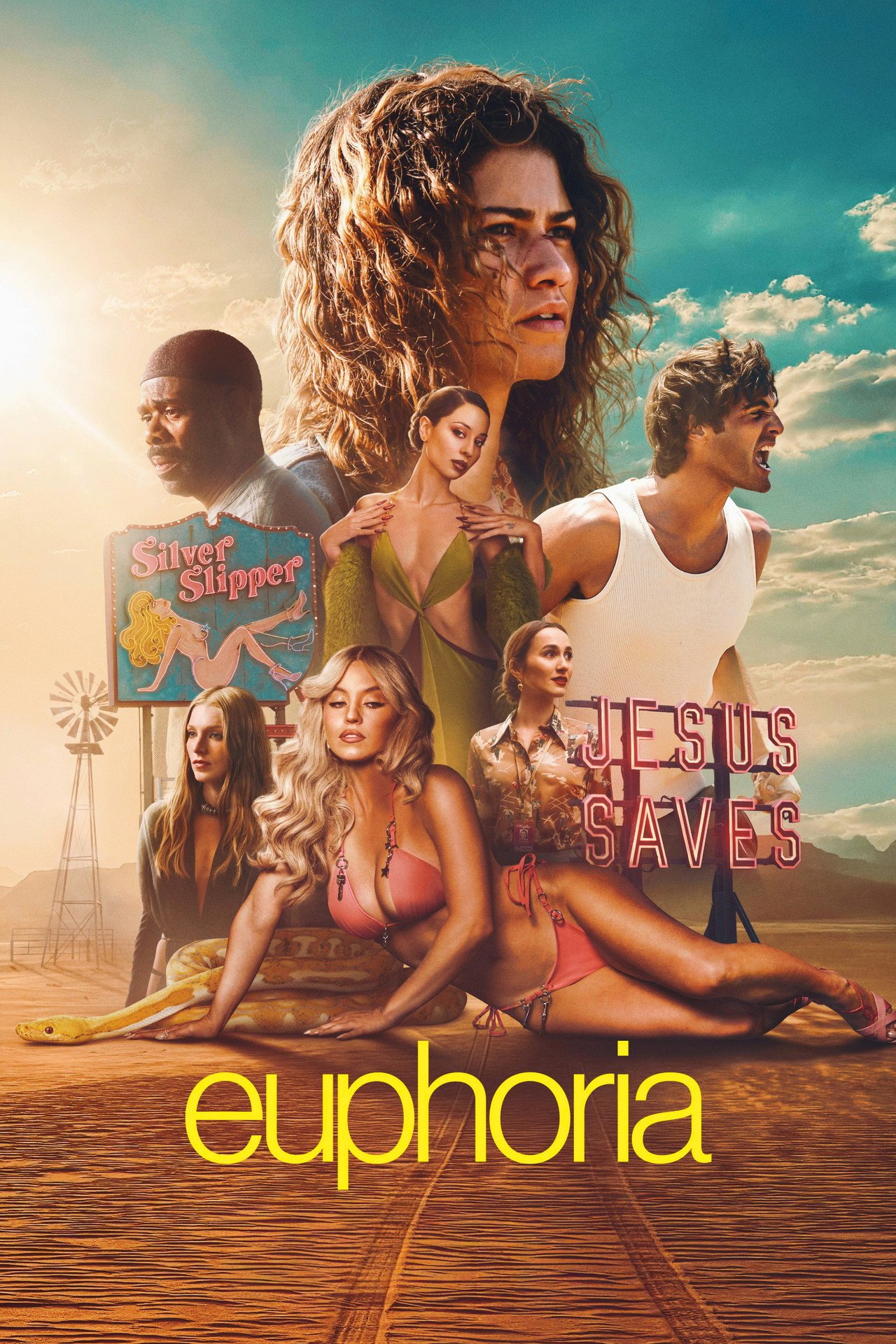
In-Depth Review: Euphoria
| Title | Euphoria |
| Type | Tv |
| Release Date | 2019-06-16 |
| Genres | Drama |
| Studio/Network | HBO |
| Director/Creator | Creator: Sam Levinson |
| TMDb Rating | 8.3/10 (10412 votes) |
| Where to Watch | HBO Max, HBO Max Amazon Channel, Spectrum On Demand |
HBO’s Euphoria is a visually stunning, emotionally harrowing teen drama that refuses to sanitize adolescence — streaming on HBO Max, it earns its 8.3/10 TMDb rating through raw performances and cinematic ambition, even when it stumbles under its own weight.
I remember watching the pilot alone at midnight, headphones on, apartment silent. By the time that rotating drug-fueled party sequence collapsed into Rue’s narration — her voice cracking somewhere between poetry and confession — I sat there thinking: this is either the most irresponsible show on television or the most honest. Six years later, I’ve landed somewhere in the middle, tilted toward honesty. Euphoria isn’t comfortable viewing. It was never supposed to be.
Overview of Euphoria
Created by Sam Levinson and premiering June 16, 2019, on HBO, the series arrived at a cultural moment desperate for something other than the glossy, consequence-free teen programming that dominated streaming queues. Based loosely on an Israeli miniseries of the same name, Levinson’s adaptation transplants the chaos into an unnamed American suburb where every kid is fighting a war most adults refuse to acknowledge.
The premise sounds almost generic on paper: high school students navigating love, identity, trauma, substance abuse, and the relentless surveillance of social media. But the execution is anything but. Rue Bennett — played with devastating precision by Zendaya — serves as our unreliable narrator, a recovering addict whose sobriety is as fragile as spun glass. Around her orbits a constellation of characters: Jules Vaughn (Hunter Schafer), the transgender new girl whose tenderness masks her own damage; Cassie Howard (Sydney Sweeney), whose desperation for male validation curdles into something darker; Nate Jacobs (Jacob Elordi), the toxic golden boy with secrets rotting inside a pristine exterior; and Maddy Perez (Alexa Demie), whose fierce exterior shields a vulnerability she’d rather die than show.
Two full seasons in, plus a pair of bridge specials filmed during the pandemic, the show has become a cultural touchstone — generating think pieces, fashion trends, and parental panic in equal measure. And with talk of a third season circulating, the conversation around it shows no signs of cooling.
My Take on Euphoria
Here’s what I keep coming back to: Euphoria made me feel seen in ways I didn’t expect and uncomfortable in ways I absolutely did. I’m not a teenager, haven’t been one for over a decade, but the emotional architecture of this show — the way longing and self-destruction share the same hallway — that rings true regardless of your age bracket.
Rewatching season 1 recently, I was struck by how much the early episodes trust the audience. There’s a patience to the pilot that season 2 occasionally abandons. That first season builds Rue’s world brick by brick, letting you understand the gravity of her addiction before the show starts detonating everything around her. By episode 3, when the full scope of these characters’ interconnected damage comes into focus, the emotional payoff feels earned — not engineered.
📖 Related: Check out similar movie recommendations
But I’d be lying if I said the show never lost me. There are stretches in season 2 where the aesthetic spectacle overtakes narrative momentum, where Levinson seems so intoxicated by the visual possibilities of a scene that he forgets the people inside it. I’ll get into specifics, but for now: this is a show I admire more than I love, and love more than I feel comfortable admitting.
📖 Related: Check out Euphoria: The Unbelievable Teen Drama You Can't Ignore
What Euphoria Gets Right (And Wrong)
Cinematography & Visual Style
Let’s address the obvious: Euphoria might be the most photographed television show of its era. Cinematographers like Marcell Rév crafted a visual language that’s immediately recognizable — saturated neons bleeding into shadows, glitter-drenched close-ups that transform teenage bedrooms into cathedrals, and camera movements that glide between dream logic and documentary grit sometimes within the same shot.
The show’s aesthetic choices aren’t merely decorative, though that accusation gets leveled often enough. When Rue relapses, the visual distortion isn’t gratuitous — it’s experiential. You’re placed inside the spiral rather than observing it from a safe distance. That rotating hallway sequence from season 1, the one that launched a thousand social media clips? It works because the technique serves the emotion. You feel the room spinning because Rue feels the room spinning.
However. There are moments when the style becomes self-indulgent. Season 2’s theatrical flourishes — I’m thinking of certain extended sequences that play like music videos detached from their narrative — occasionally cross the line from expressionistic to exhibitionistic. When every scene is a showstopper, nothing actually stops the show. The visual maximalism becomes white noise, and genuinely powerful moments risk getting lost in the glitter.
Acting Performances
Zendaya’s work here redefined what people expected from a former Disney Channel actor, and it’s worth stating plainly: her portrayal of Rue is the show’s anchor. Without her, the entire production drifts. She plays addiction not as a series of dramatic collapses but as a grinding daily negotiation — the way Rue’s eyes go vacant during conversations, the way her body language shifts depending on whether she’s high or desperate, the way her narration carries both self-awareness and self-deception simultaneously. It’s a masterclass in internalized performance.
Hunter Schafer brings an ethereal quality to Jules that makes her vulnerability feel earned rather than performed. Their chemistry with Zendaya — that tender, destructive push-pull — gives the show its emotional spine. Sydney Sweeney, meanwhile, does remarkable work with Cassie, particularly in season 2, where the character’s unraveling becomes almost physically uncomfortable to witness. Sweeney finds the specificity in desperation; there’s a scene involving a motel bathroom that I won’t describe in detail, but it’s some of the rawest acting this show has produced.
Jacob Elordi walks a nearly impossible line with Nate — you’re meant to despise him, and you do, but Elordi occasionally lets you glimpse the frightened boy underneath the monster, which is far more disturbing than simple villainy. Alexa Demie’s Maddy possesses a star quality that transcends the material; every line reading suggests a richer interior life than the script sometimes provides.
If there’s a criticism here, it’s that the ensemble’s size means some characters get shortchanged. The show introduces faces that deserve more exploration than the narrative can accommodate, and the resulting imbalance occasionally makes the world feel crowded without feeling populated.
Pacing & Story Structure
Season 1’s structure is, for the most part, elegant. Each episode orbits a specific character while advancing the collective narrative, giving the season a novelistic quality. Rue’s addiction provides the throughline, but individual episodes shift perspective in ways that expand the world organically. By the time the season finale arrives, you understand these characters as a community — not just a collection of storylines.
Season 2 is messier. The pacing lurches, with certain storylines receiving extravagant attention while others languish. There’s a mid-season stretch where the narrative momentum stalls almost completely, as if the show got drunk on its own atmosphere and forgot to keep the story moving. The theatrical bridge episodes — “Trouble Don’t Last Always” and “F*ck Anyone Who’s Not a Sea Blob” — are extraordinary standalone character studies, but they also highlight how much the main-season episodes sometimes sacrifice intimacy for spectacle.
The show’s episodic structure also suffers from inconsistency. Some episodes feel overstuffed, trying to service every character in a way that diffuses dramatic focus. Others, particularly the Rue-centric hours, demonstrate what the show can achieve when it trusts stillness over spectacle.
Soundtrack & Atmosphere
Labrinth’s score deserves its own paragraph — possibly its own essay. The music in Euphoria doesn’t accompany the visuals; it collides with them. Choral arrangements that sound like church services held in abandoned malls. Electronic pulses that mimic heartbeats and panic attacks. That main theme, with its spiraling vocal line and mounting dread, might be the most effective mood-setter of any show since Twin Peaks.
The needle drops are equally considered. The show uses licensed music not as emotional shorthand but as ironic counterpoint or thematic reinforcement. When a pop song plays during a moment of devastation, the dissonance is the point — this is what it sounds like to feel broken in a world that keeps playing the same cheerful track.
My one reservation: the score can occasionally overwhelm quieter scenes. There are moments where silence would carry more weight than another swelling synth pad. The show’s confidence in its sonic identity is admirable, but confidence and restraint aren’t the same thing.
Why Euphoria Stands Out
Teen television has been through several evolutionary cycles. The soapy melodrama of Beverly Hills 90210 gave way to the arch self-awareness of Gossip Girl, which yielded to the earnest issue-driven storytelling of shows like 13 Reasons Why. Euphoria exists in a different category entirely — closer in spirit to the original British Skins, which also refused to sanitize teenage behavior, or to Andrea Arnold’s Fish Tank, which captured adolescent female rage with similar unflinching rigor.
Where Euphoria diverges is in its formal ambition. Skins maintained a relatively naturalistic visual approach; Euphoria treats every frame as an opportunity for expressionistic world-building. It shares more DNA with the cinema of Harmony Korine or the early films of Lars von Trier than with its television contemporaries. The show’s willingness to aestheticize suffering — making devastation look beautiful without making it look desirable — puts it in conversation with photographers like Nan Goldin, whose work similarly captures self-destruction with compassionate clarity rather than moralistic judgment.
Compared to 13 Reasons Why, which also tackled teen suicide and trauma, Euphoria’s approach feels less exploitative and more observational. Where that show seemed to luxuriate in its darkness, Euphoria interrogates it. The difference matters. One shows you suffering; the other tries to make you understand it.
And then there’s the representation question. Hunter Schafer’s Jules isn’t a token transgender character shoehorned into a diversity checklist — she’s a fully realized person whose trans identity informs her experience without defining it entirely. The show’s treatment of Jules as a romantic lead, a flawed decision-maker, and a source of both tenderness and damage represents a genuine shift in how trans characters appear on mainstream television.
Is Euphoria Worth Watching?
Yes, with caveats. If you’re sensitive to depictions of substance abuse, sexual violence, or psychological manipulation, this show will test your limits — and there are stretches where it arguably pushes past productive discomfort into something more punishing. I wouldn’t blame anyone for deciding it wasn’t for them.
But for viewers willing to sit with the discomfort, Euphoria offers something rare: a portrait of adolescence that refuses both moral panic and romantic nostalgia. It captures the specific terror of being young — the way every feeling is apocalyptic because you haven’t yet learned that intensity fades. The show takes its teenage characters seriously as people rather than reducing them to punchlines or cautionary tales, and that respect extends to its audience.
The performances alone justify the investment, particularly Zendaya’s and Schafer’s. The visual artistry provides rewards even when the narrative falters. And the emotional honesty — when the show commits to it fully — hits with a force that most television simply can’t muster.
Start with season 1. Give it at least three episodes before making your judgment. The pilot is deliberately disorienting, and the show’s rhythms take time to settle. If by episode 3 you’re not invested, the show probably isn’t speaking your language. But if Rue’s voice catches you — that weary, wry, desperately hopeful voice — you’ll find yourself pulled into something genuinely singular.
📰 More From Watchlist Wizard
Frequently Asked Questions
Is Euphoria season 3 confirmed?
HBO has confirmed that a third season is in development, though production timelines have shifted multiple times. As of the most recent updates, the new season appears to be moving forward, though specific premiere dates remain unannounced. Fans should temper expectations for an imminent release.
What episode is Sydney Sweeney in Euphoria?
Sydney Sweeney appears as Cassie Howard throughout both seasons of the show. Her character becomes increasingly central as the series progresses, with season 2 giving her a substantially expanded role compared to her season 1 arc. She’s present from the pilot onward.
Did Sara Arjun act in Euphoria?
No — Sara Arjun does not appear in the cast of Euphoria. This appears to be a case of mistaken identity or confusion with another production. The show’s main cast features Zendaya, Hunter Schafer, Sydney Sweeney, Jacob Elordi, and Alexa Demie among its core ensemble.
What the heck is Euphoria about?
At its core, the series follows a group of American high school students as they navigate identity, trauma, addiction, and relationships in an era defined by social media and constant surveillance. Rue Bennett, a teenage addict fresh out of rehab, serves as the unreliable narrator and emotional center. The show explores how these young people cope with — and sometimes perpetuate — the damage around them, all rendered in a visually expressionistic style that mirrors their inner lives.
Ready to watch Euphoria?
Check out our complete streaming guide to find out where you can watch it right now.