
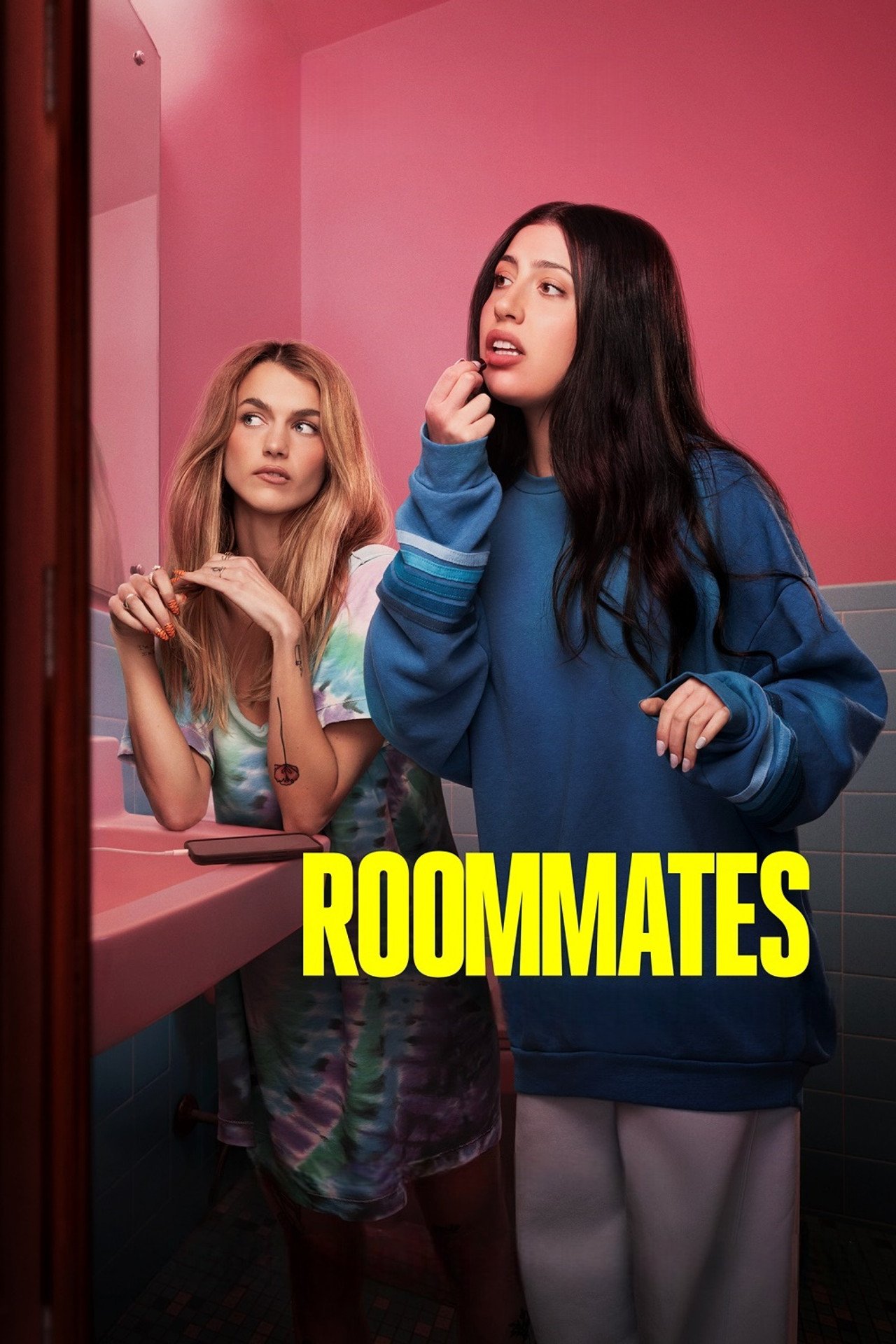
Ending Explained: Roommates
| Title | Roommates |
| Type | Movie |
| Release Date | 2026-04-13 |
| Genres | Comedy |
| Runtime | 108 min |
| Studio/Network | Happy Madison Productions |
| Director/Creator | Director: Chandler Levack |
| TMDb Rating | 6.4/10 (21 votes) |
| Where to Watch | Netflix, Netflix Standard with Ads |
Roommates ends with Devon and Celeste reaching a fragile détente after their passive-aggressive war destroys their friendship—only to rebuild it on honest ground. The closing shot suggests their bond, though scarred, might actually survive.
I went into Roommates expecting another Happy Madison sugar rush—broad jokes, sentimental wrap-up, credits rolling over a blooper reel. What I got was something messier and more honest. Chandler Levack, directing from within Adam Sandler’s production empire, has made a college comedy that actually understands how terrifying it is to share 200 square feet with a stranger who controls your sleep schedule. The film’s finale stuck with me for days, and not because of any big twist. It’s the quiet stuff that lingers.
What Happens at the End of Roommates?
The basic architecture of the story is simple enough: shy freshman Devon (Sadie Sandler) asks the effortlessly cool Celeste (Chloe East) to be her roommate, and what starts as an aspirational friendship curdles into psychological trench warfare. Post-it notes escalate to sabotage. Sabotage escalates to genuine cruelty. By the third act, their dorm room feels less like a living space and more like a demilitarized zone with a mini-fridge.
Levack structures the escalation with genuine craft. Early micro-aggressions—a borrowed sweater returned unwashed, a 2 AM phone call taken without apology—accumulate like interest on a bad loan. By the time the conflict peaks, neither character remembers how the fighting started. That’s the point, and it’s a point the ending refuses to let you dodge.
The resolution doesn’t arrive through some grand gesture or tearful confession. Instead, Devon and Celeste are forced into proximity by a housing mix-up during finals week—there’s literally nowhere else to go. Stripped of their arsenals and their audiences, they have to exist in the same space without performance. What emerges isn’t forgiveness, exactly. It’s exhaustion. And that exhaustion curiously, convincingly, becomes the foundation for something real.
Breaking Down the Final Scene
The last sequence is where Levack’s direction elevates the material above its genre trappings. Devon and Celeste sit on their respective beds—the room divided, as always, by an invisible border—studying in silence. The camera holds on them from an overhead angle that makes the room look like a diorama, two small figures arranged in parallel. No dialogue for nearly ninety seconds. Just the ambient noise of dorm life bleeding through thin walls.
Then Celeste slides a coffee across the boundary line. Not an apology. Not even an acknowledgment. Just coffee. Devon takes it. The overhead shot holds. Credits.
What makes this work is everything Levack refuses to do. There’s no hugging, no monologue about friendship, no acoustic song swelling to tell you how to feel. The coffee is transactional, almost clinical—and yet it contains more emotional truth than a dozen theatrical reconciliations. These two people have hurt each other too deeply for a clean resolution. What they can manage is coexistence. Whether coexistence becomes friendship again is left deliberately, beautifully ambiguous.
Aidan Langford’s Alex and Natasha Lyonne’s Hannah exist at the edges of this finale, and their placement is intentional. Alex represents Devon’s attempt to build a social life outside the roommate dynamic—proof that she can connect with people when she’s not performing for Celeste’s approval. Hannah, the RA who’s seen a thousand dorm wars, offers the weary adult perspective that none of this will matter in five years. Nick Kroll’s Brian, Celeste’s dad, appears in a brief phone call that reminds us these are still kids learning to be people. The supporting cast doesn’t crowd the ending; they frame it.
Hidden Details You Might Have Missed
On rewatch, Levack’s visual storytelling reveals layers that glide past on first viewing. The room itself undergoes a transformation that mirrors the relationship: early scenes feature warm, overlapping light where both sides blend together. As the conflict intensifies, a literal line of tape appears on the floor—barely noticeable at first, then impossible to ignore. By the finale, the tape is gone, but the ghost of its adhesive residue remains visible if you look closely. That residue is the whole movie in a single detail.
The post-it notes deserve their own analysis. Devon’s early messages are written in neat handwriting on perfectly square notes—organized, controlled, desperate to please. Celeste’s responses come on torn scraps, handwriting loose and rushed. As the war escalates, their handwriting styles start bleeding into each other. Devon’s notes get messier; Celeste’s get more deliberate. They’re becoming each other, which is exactly what makes the conflict so vicious. You don’t fight that hard with someone who doesn’t reflect something you recognize in yourself.
There’s also a recurring bit with a shared Spotify playlist that functions as emotional shorthand. Songs keep getting added and removed in real time—a passive-aggressive DJ battle that says more than any argument scene. The final song on the playlist, playing softly during the coffee moment, is chosen by neither of them: it’s a track the algorithm added. Even their taste has been colonized by a third party. For a movie about boundaries, it’s a sly commentary on how porous those boundaries actually are.
What Does the Ending Mean?
Thematically, Roommates is wrestling with a question that most college comedies are too cowardly to ask: what happens when proximity doesn’t create connection? The genre typically assumes that throwing mismatched people together inevitably produces friendship—think of every odd-couple narrative from The Odd Couple to Step Brothers. Levack isn’t interested in that guarantee. Her film suggests that forced intimacy can breed genuine resentment, and that resentment doesn’t magically dissolve when the credits need to roll.
The ending’s refusal to grant full reconciliation is its boldest choice. Devon and Celeste haven’t resolved their core incompatibility. Devon still needs more emotional closeness than Celeste wants to give. Celeste still guards her independence with weapons-grade deflection. The coffee isn’t a peace treaty; it’s a cease-fire. And for anyone who’s actually lived through a toxic roommate situation, that distinction feels painfully accurate.
The film also has something sharper to say about performative femininity in shared living spaces. Devon’s shyness isn’t innate—it’s a strategy she’s been taught to deploy. Celeste’s coolness isn’t authentic either—it’s armor. Both performances require an audience, and once that audience becomes hostile, the performances collapse. What’s left in the finale are two tired people who’ve run out of energy for pretending. That exhaustion is the most genuine emotion either has displayed, and Levack treats it with genuine respect.
At 108 minutes, the movie earns its quiet ending precisely because it’s taken the time to make the noise feel consequential. A shorter cut would’ve forced a tidier resolution. The runtime allows the conflict to breathe, to become tedious and circular and genuinely frustrating—just like real interpersonal conflict actually is.
Fan Theories Worth Considering
The online discourse around Roommates has produced a few readings worth engaging with, even if I don’t buy all of them.
The “Mirror” Theory: Several viewers have argued that Devon and Celeste are essentially the same person at different stages of social development—Devon is who Celeste was before she learned to perform confidence, and Celeste is who Devon fears becoming if she never lets anyone in. It’s an attractive reading, and the handwriting detail certainly supports it. But I think it slightly oversimplifies what Levack is doing. The characters share traits, yes, but their coping mechanisms are fundamentally different. Devon internalizes; Celeste projects. The mirroring is real, but it’s imperfect—and that imperfection is what generates the friction.
The “Unreliable Narrator” Theory: This one posits that we’re seeing events entirely through Devon’s perspective, and Celeste’s cruelty is exaggerated by Devon’s insecurity. It’s a clever angle—there are moments where Celeste’s behavior reads as thoughtless rather than malicious, and Devon’s interpretation fills in hostile intent. But the film gives us too many scenes where Devon isn’t present for this to hold up as a full reading. Levack wants us to see both sides, even if she doesn’t give them equal weight.
The “Cycle” Theory: Perhaps the most unsettling interpretation. The final overhead shot mirrors the film’s opening shot almost exactly—same angle, same room, two people on parallel tracks. The suggestion is that this détente is temporary, and the cycle will begin again with the next stressor. I find this reading persuasive but not definitive. The coffee gesture introduces a variable that wasn’t present at the start: voluntary small kindness without expectation of reciprocation. Whether that’s enough to break the cycle is the question the movie wisely leaves open.
📰 More From Watchlist Wizard
Frequently Asked Questions
Is Adam Sandler’s daughter in Roommates?
Yes—Sadie Sandler, Adam Sandler’s daughter, stars as Devon, the shy freshman at the center of the story. This marks one of her most substantial roles, and she handles the character’s emotional arc with surprising restraint. The casting through Happy Madison Productions keeps it in the family, but Sadie earns the part on merit rather than nepotism alone.
What is Roommates on Netflix about?
The film follows Devon, a shy college freshman, who asks the confident Celeste to be her roommate. Their initial friendship devolves into a war of passive aggression as their contrasting personalities clash in the pressure cooker of shared dorm life. It’s a comedy, but one with genuine teeth and an unusually honest emotional core.
Is Roommates based on a true story?
No, Roommates is not based on a specific true story. However, the dynamics it portrays—passive-aggressive roommate conflicts, the performance of social identity in college, the terror of enforced proximity with a stranger—will feel autobiographical to anyone who’s survived freshman housing. The specificity suggests lived experience, even if the particulars are fictional.
Is Megan Thee Stallion in Roommates?
No, Megan Thee Stallion does not appear in Roommates. The cast features Sadie Sandler, Chloe East, Aidan Langford, Natasha Lyonne, and Nick Kroll. Any rumors suggesting her involvement appear to be fan speculation rather than fact.
Roommates isn’t a perfect film. Its 6.4 TMDb rating reflects a certain unevenness—the second act drags, and some of the supporting characters feel sketched rather than drawn. But the ending is where Levack’s vision crystallizes into something worth taking seriously. In a genre that usually rewards dishonesty with feel-good closure, this movie chooses the harder path. Two people sit in a room. One slides the other a coffee. Nothing is resolved. Everything has changed. That’s not a cop-out—it’s the most honest thing a college comedy has said in years.
Ready to watch Roommates?
Check out our complete streaming guide to find out where you can watch it right now.